For a minute, I want you to picture all the animals you can think of.
Did you picture a cat? A mouse? A dog? A platypus? Did you picture a human at any point? After all, we’re ultimately classified as animals, regardless of our cognitive abilities.
On the flip-side, would you ever regard an animal as human?
Despite our tendency to regard humans and animals as separate, we have nonetheless spent thousands of years depicting animals as humans. We’ve seen this practice in cartoons, books, and other forms of media, like Spongebob Squarepants and Charlotte’s Web. The concept of giving animals human qualities is known as anthropomorphism.
The Bodleian Bestiary is one of the earliest manuscripts detailing the practice of anthropomorphism. Here, animals from the mighty lion to the teeny mouse are all categorized separately, with each folio denoting their humanistic traits and abilities.
In spite of its almost-encyclopedic qualities, however, I must warn that the bestiary is not meant for educational purposes. According to Professor Rebecca Davis of UCI, this “book of beasts” was written for an ideological purpose – particularly dealing with Christianity. This is evident in the fact that many of the entries contain biblical allusions, such as the panther symbolizing Jesus Christ and the wolf symbolizing the devil.
It’s impossible for me to describe the bestiary in it’s entirety to you. Instead, I’ve drawn a collage describing the wolf and dog’s portrayals in the bestiary, which you can scroll down to see. Before we delve into the collage, I’d like to give you an opportunity to check out the links below, where you’ll find digital copies of the Bodleian and Aberdeen bestiaries.
Given their biological similarities, I was surprised to note that these animals are described as near-opposites in the bestiary. Further research has lead me to attribute their descriptions to their respective upbringings.
Being a domesticated animal, the dog is virtuous as a result of being influenced by mankind – who, as described in the Bible, is considered to be God’s greatest creation. Thus, this closer connection to the divine world is what grants the dog its holy traits, such as harboring fierce loyalty and having the ability to cleanse “wounds of sin”. The dog could be an allusion to Christ, who sacrificed himself for humanity so that their sins could be forgiven.
Meanwhile, being a wild animal, the wolf lacks this godly connection, ultimately resulting in its association with the devil. Unlike the dog who is dependent on man, the wolf is “envious of man”, a possible allegory to Lucifer and his jealousy towards mankind, which is what ultimately resulted in his fall from grace. The bestiary depicts the wolf as violent and an enticer of sin, seeking to corrupt others’ souls.
In summary, despite their biological relations, the Bodleian bestiary chooses to place these two animals on opposing ends of the biblical spectrum – the dog as a forgiver of sin and the wolf as a tempter of sin.
Works Cited
Lupton, Julia. “Into the Animated Woods.” Humanities Core Lecture. Anteater Learning Pavillion, Irvine. 5 November 2019. Lecture.
With Spring Quarter shifting to an online environment, I initially found it extremely daunting to have to also deal with a research project remotely. Losing physical, in-person access to the UCI Libraries made the research process much more stressful. Fortunately, with remote access to the UCI Libraries being available through their online Library Search tool, my worries over the research project lessened. I won’t deny, however, that I did initially have trouble using these sources, especially since many of them seemed inaccessible no matter how many times I logged into my UCI Account. Upon further inspection on how to set up my UCI VPN account, this issue immediately dissipated. (Note to self, read instructions clearly and carefully from now on!)
Moving on to my research topic itself, I decided to use Animal Crossing: New Horizons as my primary source for two main reasons. For one, given my prior experience with video games, I wanted to challenge myself to see if I could analyze such a media type just as I had previously done with books, films, plays, and articles in other past courses. Although sources related to my specific game choice were scarce, with most being related to earlier titles in the Animal Crossing franchise, I was nonetheless surprised to discover the wide range of scholarship available that dealt with video games. Because of the negative stigma surrounding video games, I feared that such a source would result in few academic sources, and would thus need to change my research topic. Fortunately, these resources were plentiful. In fact, two of my sources – The Routledge Companion to Video Game Studies and How to Play Video Games – provided a plethora of different scholarly discussions discussing various aspects of video gaming, particularly genre and customization.
My other reason for choosing Animal Crossing: New Horizons was because of how significant the game became for me, especially given our ongoing circumstances over coronavirus and social distancing procedures. I turned to ACNH as a way to cope with all the stress that had suddenly been imposed on me, given its casual, relaxing elements that aren’t as common in other games I’d previous played. In addition, with my social life at a standstill due to lockdown, this game turned into a “hang out” spot of sorts for me to continue communicating and interacting with my distant friends.
Although I’m still heavily revising my research paper, I’m hoping my findings will encourage others to experience the game for themselves as well as begin to reduce the stigma against this media type.
Animal Crossing: New Horizons (ACNH)is the latest entry of Nintendo’s Animal Crossing franchise, a Japanese life-simulation game series that first launched in 2001 under its localized name Dobotsu no Mori. Published for physical and digital purchase on March 20, 2020, the game sold approximately 11.77 million copies worldwide within only 12 days of its release, outselling the lifetime sales of earlier titles in the franchise like Animal Crossing: New Leaf (2012) and Animal Crossing: Wild World (2005).
Animal Crossing: New Horizons trailer revealed at the Electronic Entertainment Expo in 2019 (E3).Interesting how the trailer advertises the game as a stress-free island getaway, but then ends with Tom Nook reminding you of your newfound debt.
The game begins with you checking in with Tom Nook’s nephews in preparation for your island getaway trip. Image Source: Meet Timmy and Tommy Intro Dialogue
ACNH’s story begins with you and a pair of anthropomorphic animals sailing away to an island as part of Nook Inc.’s aptly-named “Deserted Island Getaway Package”. After arriving and taking charge of the island’s settling procedures, you are eventually promoted to the position of “Resident Representative”, where you are now responsible for beautifying the island to raise its ranking and attract the attention of more travelers. Although the game continues indefinitely, the plot “concludes” once your island is popular enough to convince famed musician K.K. Slider into visiting and performing a concert for you and the villagers.
Compared to earlier titles, many have attributed this game’s success to its coincidental release in the midst of the ongoing coronavirus pandemic. With the world under lockdown, many have turned to this title as a distraction tool, hoping to find some solace away from their newfound pressures. As we will soon discuss in-depth, players have turned to this game due to its inclusion of real-time progression, customization features and lack of consequences, all of which allow the player to uniquely personalize their gameplay experience and be able to enjoy the title without any sort of additional pressure.
Argument:
Everyone’s been talking about it, but why haven’t you stepped in to help? 😦
While many players and scholars attribute the game’s (and the franchise’s as a whole) popularity to its escapist elements, the labor-intensive game mechanics within ACNH seem to contradict the supposed relaxation the player is meant to be experiencing. For instance, even though the player is technically vacationing on their island getaway trip, you eventually end up being “hired” (though without a paycheck) by Tom Nook to help transform the island from a deserted, weed-ridden area to a beautiful, bustling tourist spot. Aside from this responsibility, as you gradually expand your home, you must also pay a series of home loans, all of which sum up to a grand total of 5,696,000 Bells! In addition, despite the non-playable characters’ (NPCs) tendency to use “we” in their discussion of island contributions, the majority of the work falls on your shoulders alone. With a newfound job and home-loans to pay, how exactly is this supposed to be an escape if it’s an echo of your stressful, real-life responsibilities?
Despite this contradiction, further analysis of the game’s features seems to cement ACNH’s title as an escapist media, while simultaneously also turning it into the player’s idealized world. For example:
You can wear what you’d like, no matter your gender identity, and receive nothing but compliments and praise from your fellow villagers.
The game changes its landscape visually every season depending on whether you live in the Northern or Southern Hemisphere, giving the player the chance to play within an environment familiar to them and echoing that of their own real-life.
The Pro Designs application, which lets you design your own clothing and artwork and be able to share these designs online with other players. Although the development of these designs has no influence on your island’s development, players are still drawn to this feature because it gives them a chance to socially exchange with other players and be able to display and receive recognition for the in-game efforts.
By being able to customize the island itself, the island tune, the island flag, and the island name without any sort of input by the other villagers, the player is given the chance to freely express themselves without any sort of judgement.
The lack of consequences when it comes to loan-paying (no interest accrued) as well as mission completion (no time-limits) allows players to play (or work) comfortably at their own pace, and yet still receive the same amount of praise from the villagers – something that can’t be guaranteed in real-life where efficiency is heavily strived upon.
Therefore, while at first glance, the game’s “escapist” title seems rather contradictory, close study of its game mechanics serves to fully establish this description. Though given these work-intensive features, describing ACNH as a purely escapist source would reveal only half of the game’s themes. Instead, it can be described as both escapist and a “pseudo” return to normalcy. While the gameplay mechanics are labor-intensive, the inclusion of personalization features and the flexibility that comes with task completion grants players both a nostalgic reminder of their eventful life before the pandemic but also a medium through which they can freely act and express themselves without any sort of social or financial repercussions.
Potential Contributions:
Games studies professor Ian Bogost wrote an article about “The Quiet Revolution of Animal Crossing” , which was one of the few scholarly sources I discovered that discussed ACNH specifically. My other sources were concerned with earlier titles in the Animal Crossing franchise.
Given that there is very little scholarship on ACNH itself (since it is only two months old), I’m hoping my research will serve of use to other individuals interested in studying this title.
In addition, unlike other sources related to the Animal Crossing games, my research puts a heavy emphasis on the discussion of the game’s Pro Designs feature and its online sharing capabilities, a mechanic known in the gaming community as user-generated content (or UGC). While some scholars critique the development of UGC as a “unpaid second job” – given that it enhances the gameplay experience of other players of which the game developers are supposed to be solely responsible for – my research instead describes UGC in less negative terms, arguing that UGC gives players the opportunity to develop their skills (particularly in design) and be able to feel a sense of achievement from their efforts through the repeated download and use of their creations. With players under lockdown and many losing their jobs, the development of UGC becomes a medium through which they can still work hard and receive recognition for their efforts.
As someone who’s been playing the game since launch day (with over 135 hours accrued), I was interested in pursuing this research topic because I wanted to analyze what features have greatly contributed to the game’s explosive popularity, as well as to answer whether our current circumstances could also be cited as an influence.
In addition to my interest in the game, my decision to study ACNH was largely based on my desire to challenge myself, since I had never before had the opportunity to analyze this media type before. Seeing as how I’ve only been analyzing books, films, articles, and plays for most of my time in school, I was interested in seeing whether video games could also be subject to the same scholarly scrutiny as these other types of media. As aforementioned, while it was difficult to find secondary sources specifically related to the Animal Crossing franchise, it was nonetheless surprising for me to see the vast range of video game-related scholarship available online. As someone who has always faced judgement for my passion for video games, it was a bit comforting to see so many professionals studying and writing scholarly papers related to their findings with this media type.
In relation to our theme of Animal/Culture, this is an interesting source to study due to its inclusion of anthropomorphized animals and their interactions with the human player. It is interesting to note that the player is the only canonical human character within the game’s story. With over 480 villagers total and 35 different species, it’s no surprise that the player might feel a sense of loneliness within their in-game environment. To add, this loneliness might seem further exacerbated through their promotion to Resident Representative, as it now seemingly puts them in a position of authority over the animals. But in spite of this newfound “power”, it is interesting to see that the animal villagers still treat the player positively and continue to regard them as an equal. As time passes, my hope is that more scholars will begin to study and discuss the significance of the human-animal equality portrayed within the game. Since my secondary sources were mostly concerned with the game’s customization and work-related features, it’d be refreshing to see further discussion of the game’s social aspects.
In conclusion, I highly recommend you check out this source however possible, whether it be through the viewing of YouTube playthroughs or by actually purchasing the game. As someone who was skeptical of finding enjoyment in such a casual game, my time playing ACNH has been nothing but pure relief and enjoyment, making me wish I had given this franchise a chance much earlier in my life.
My villagers and I celebrating the reopening of the newly-expanded Nook’s Cranny.
Initially, I had planned to only discuss and analyze the game’s various human-animal relationships and explain whether these fictional interactions helped to heavily popularize the game given our current circumstances. However, this evolved into a daunting task upon learning that the game has a whopping 400 different animal characters. To analyze a majority of them in a 12-15 page research paper just didn’t seem feasible.
It was only until I searched for possible secondary sources that I uncovered a much more interesting aspect of the game to analyze. A common agreement amongst scholars is that the Animal Crossing series is notable for its balance between relaxation and productivity. Here, in order to make money and pay off your home loans, you have to sell the items you collect from either catching bugs, fishing, foraging, harvesting, collecting sea shells, crafting, or investing. To do this for loans amounting to a whooping 5.696 million Bells seems tedious, so why is the game still so appealing? Fortunately, there is no “time limit” to paying off loans, nor are there any consequences or interest you accrue if you fail to pay them. You can pace yourself however you’d like, or instead just focus on collecting all the fish, bugs, fossils, furniture, and recipes for your own leisure.
Ultimately, I want to argue whether this title is popular because it allows players to return to normalcy – that is, by putting them to “work” – while simultaneously distracting them from the difficulties stemming from the pandemic.
One pressing issue I encountered while looking for potential secondary sources was the lack of scholarship dealing with this game title in particular. It’s understandable, given that the game is only about a month old. As a result, a majority of the sources I collected discuss earlier titles in the Animal Crossing franchise, particularly Animal Crossing: New Leaf (2012) and Animal Crossing: Wild World (2005). While the context in which these games were published in are vastly different compared to Animal Crossing: New Horizons, I will nonetheless rely on them to illustrate how the aforementioned themes and game mechanics are present throughout the series and how they’ve contributed to its overall popularity.
As I’ve stated in previous blog posts, video games have been a crucial part of my life. In fact, they’ve been a prominent influence behind my major choice and career plan. Therefore, my interest in researching Animal Crossing: New Horizons and potentially the franchise as a whole is mostly attributed to my love and experience with this form of media. An additional motivation behind choosing this topic is my goal of clearing common misconceptions about video games. As someone who regularly hears that “video games cause violence”, I want to be able to break this stigma and show skeptic readers that video games can be therapeutic as well, and that not all of them have violence or gore in them as is widely stereotyped.
By my next post, I’m hoping to read more in depth into my secondary sources and be able to uncover additional details to support my analysis.
In my previous post, I pondered working with the topic of humans relying on animals for social and emotional support. With this topic in mind, I’ve found three primary sources to help develop my research.
The first is Animal Crossing: New Horizons, a video game developed by Nintendo and released on March 20, 2020 for the Nintendo Switch console. In this game, you live amongst anthropomorphic animals on an uninhabited island, where your job is to beautify the area to garner more tourism. Aside from being a game I’m familiar with, I’m also interested in what has made this game so appealing to a world struggling with isolation. Human-to-human interaction with this game is pretty costly (needing to purchase a 20$ online membership for all parties involved), so why is this game still so popular in our socially-isolated world when a majority are just playing with the games’ animal villagers? In addition, I’d like to explore the games’ underlying messages when it comes to human-animal interaction. For instance, in the games’ world, where humans and animals are pretty much equal (in terms of behavior and physique), why is the human still the leader?
Garfield Minus Garfield (Top) in comparison to the original strip (Bottom). (Laugh Tracks, gocomics.typepad.com/laughtracks/2008/11/page/2/.)
My second and third primary sources are both comic strip series: Garfieldby Jim Davis, and Garfield Minus Garfieldby Dan Walsh. I’m familiar with the former since my childhood, but its cat-less counterpart was recently introduced to me by another HumCore peer. Surprisingly, removing the comic’s titular character drastically changes the atmosphere of these panels. With the left panels as an example, the comedic interaction between a middle-aged man and his English-thinking cat transitions into a lonely man’s depressive episode once his pet is removed. For my research paper, I’d like to be able to explore the meaning behind this phenomenon – and whether or not the comics’ hidden dark nature was something the author originally envisioned, with Garfield acting as a source of support for Jon’s struggles.
Although I still haven’t decided on a main primary source to work with, I’m hoping that further research into the availability and credibility of secondary sources will help me narrow down the decision. To look for credible secondary sources, I’m mostly using Google Books, since it has an easy, versatile interface to navigate with. To narrow my search, I’ve used a number of Google Search tricks, like adding a dash before a word in order to remove all search results containing that word. The following infographic on the right provides three of many of these tricks, and the rest can be found on the provided link.
One thing I was surprised to find in my research was the sheer number of academic works related to the study of video games! Before, I had assumed that academic research was restricted solely to the study of things like books, poems, journals, and films. With this newfound knowledge, I’m hoping I can put my own experience with video games to work in order to determine what the best possible sources for my research paper should be. This will especially be useful given the fact that my video game-related source is less than a month-old, so I’ll need as many relevant scholarly works possible to help me interpret such a young title.
In summary, my goal for the next few days is to choose a primary source I’ll best be able to interpret, so I can begin gathering sources to help develop my argument.
A reliance on animals has been a normal practice for much of human history. They’re a form of transportation, entertainment, and even nutrition! But with the advent of modern society, we’ve slowly begun to distance ourselves from this exploitative role. They’re companions now, and for some, even family.
Why are animals becoming more mainstream in our modern society? Why are we beginning to include them in our definition of family, despite our obvious biological differences? This was a concept I had first explored during my winter quarter of Humanities Core, more prominently in the blog post titled “Animals are Family.” As I mentioned in post, my interest in this topic was motivated primarily because I could relate to it, as I too find animal companionship to be an extremely important part of my life.
Aren’t those for human babies?
Professor Imada introduced this topic by describing the experiences of Gertrude Kaauwai – a leprosy patient living in the Kalaupapa Settlement – and Ronnel Draper – an inmate at the San Quentin State Prison. Within their respective sources, the two discuss their strong bond with animals and how they came upon forging them. The two admit that these relationships grew because they were ostracized from their original society, and thus fulfilled their desire for socialization through animal companionship.
In addition to these aforementioned sources, I want to include accounts of other individuals and their non-human friendships. While Kaauwai and Draper were both prisoners, there are other individuals in vastly different circumstances who share the same experiences with animals. Aside from that, I also want my additional sources to come from different geographical settings. Kaauwai and Draper are both based in the United States, so I want to ensure that my research and findings are applicable on a wider cultural scale.
Does the frequency of the term “millennials” indicate that this is a generational phenomenon?
There are a number of questions I’m hoping my research will answer. Is human-animal companionship becoming widespread out of an economical circumstance? A social one? Or is this mostly an ethical one? Is this practice a way to “relieve” our guilt over having treated these creatures so poorly in the past?
This’ll be my first major research experience, so I’m excited for what surprises and discoveries await!
Image: “10 Scientifically-Backed Tips for Getting a Cat to Like You” by Mikel Delgado. 2018. Mental Floss.
What does the word “family” mean to you? What about the word “friends”? For you personally, who falls under these terms? For many people, these words aren’t solely reserved for human beings.
Dr. Adria Imada, an Associate Professor of History at the University of California, Irvine, approached these questions in a recent lecture of hers. Here, she argues how disadvantaged individuals have come to cope with their difficulties in society by developing close relationships with animals.
The setting of Dr. Imada’s lecture is the Kalaupapa settlement on Molokai, which was a “medical prison” established in 1866 that was meant to isolate Hawaiian and Asian leprosy patients. In her lesson, Dr. Imada turns to the 2011 documentary “Kalaupapa Heaven”. She is particularly focused on the documentary’s inclusion of a 2006 interview with Getrude “Gertie” Kaauwai, a then 74-year old patient who had been living in the settlement for nearly 62 years.
As a hobby, Gertie took great pleasure in being the caregiver of dozens of cats. She happily admits that at one point, she owned over fifty cats! Citing similar interactions between other Kalaupapa residents and animals, Dr. Imada had us infer the possible motivations behind these interspecies relationships.
In Gertie’s case, my peers and I believed this was a coping mechanism for her, mostly given the fact that she lost her chance for motherhood. In her interview, Gertie melancholically recalls her four lost children, all of whom were snatched away immediately after birth for fear of contracting their mother’s illness. Unable to care for her children normally, Gertie saw these cats as a way for her to project those still-lingering maternal instincts.
Another possible reason behind her behavior might stem from her experiences as a leprosy patient. In her interview, she recalls the strange looks she’d get from strangers due to the physical changes her illness caused. Although her late husband would step in to defend her, this behavior nonetheless still afflicted her, causing her to feel further isolated in society. To Gertie, interacting with her cats gave her a chance to socialize, albeit without having to worry about the stigma towards her condition. After all, cats don’t care about how you look, act, or talk – they’ll love you all the same as long as you treat them with compassion.
Illustration of Rauch by Antwan Williams
Similar interspecies friendships are explored in the Ear Hustle podcast episode called “Looking Out”, which Professor Imada had assigned to us to listen to. Based in the San Quentin State Prison, Ear Hustle is a podcast focused on describing the various experiences faced by prisoners in this facility. In this episode, we are introduced to Ronnel “Rauch” Draper, who recounts his relationship with animals whilst in prison.
Rauch describes his strained relationship with society, admitting that people “have been a source of pain for him”. Recounting his difficult childhood and the events that transpired leading to his incarceration, he explains that he likes animals because he “communicates with them better than [he] can people”. He failed society and society failed him, but that didn’t mean Rauch was doomed to a life of eternal solitude. During his time in prison, Rauch coped with these feelings by taking care of a wide variety of animals, including moths, spiders, bees, crickets, frogs, swallows, voles, and snails.
As to why he refuses to call these animals his pets, Rauch states: “I do not call animals pets. I call them critters. I hang out with these guys or girls. They’re friends. I don’t own them.” He enjoys taking care of them because they “teach [him] what he can’t learn from people. It’s unconditional affection or appreciation.” He humanizes them to an extent, again reiterating that these creatures were his way of fulfilling the friendship he failed to make with humans in the outside world. While Rauch makes his sentiments more explicit, they nonetheless parallel Gertie’s more implicit ones. Feeling like outcasts in their respective societies, the two find comfort in their animal companions.
Here’s the cat tax.
On a more personal note, while my experiences are nothing similar to Gertie’s or the San Quentin prisoners, I can relate to the strong bond they have with their animals. As an introvert, it’s hard to maintain human interactions. Engaging with them willingly is a whole different struggle on its own. But despite my aversion to socializing, I won’t deny it gets lonely having few people to talk with. Luckily, that’s where my cat Rowena comes in. Sure, she doesn’t exactly understand what I’m saying when I talk to her (except when I say “food”, you should see the way her ears perk up). With her, however, I can’t exactly say I’m alone. She’s someone I can happily spend hours with and never get bored. It’s not your typical human-to-human interaction, but I’m satisfied with it.
A family doesn’t necessarily have to be blood related to you, nor does a friend have to be human. If we ignore our biological differences, we humans can come to consider animals as our companions against a world that’s out to get us.
As an extra, here’s another cat picture, because just one isn’t enough.
Image: “How to Read a Book a Week: Step by Step Guide” by Sean Kim. March 6, 2017. INC.
When you were assigned reading for homework, did you ever feel as if you couldn’t recall half of what you had read? If you were asked a series of questions about the text, do you think you could answer them all? This problem becomes increasingly common with longer and more difficult texts. Luckily, there’s a solution to this problem, one that doesn’t involve reading the text hundreds of times again.
If you want to be able to regurgitate what you’ve read in a clear and concise manner, you should use annotations. Annotations enrich your reading of a particular text by getting you to interact with it. Rather than simply skimming through, you can build a stronger understanding with the text by physically identifying key points and making numerous mental connections.
How do we annotate? The short explanation is that we simply highlight and jot down notes next to the important parts of the text. “But wait,” you might ask, “isn’t everything in the text important? Won’t we simply just be coloring the pages yellow until our highlighter dies out?”
I’m here to tell you that no, annotating isn’t some coloring exercise. In this guide, I’ll give you tips and tricks on how to annotate, showing you what components of the text your brain and marker should hone in on. My hope is that you’ll be able to apply these skills to other scholarly texts you encounter in the future.
For this exercise, we will use certain paragraphs taken from the ninth chapter of Irene Silverblatt’s Moon, Sun, and Witches. I will provide images that detail my own annotations with this text to serve as examples.
Annotate Elements of the Author’s Argument!
If you want to understand a text better, you first need to focus on the text’s main idea, which is usually synonymous with the author’s argument. To start, you will first need to find and identify the author’s thesis statement, which is usually located at the start of the text. The thesis statement acts as a sort of preview for the rest of the text, as this includes the author’s claim and what type of evidence they will focus on in order to prove that claim. As an added note, the thesis statement’s length can vary between one sentence to multiple ones.
From there, you can begin to find and study the evidence used by the author to support their claim, as well as the analysis that accompanies it. The majority of your annotations will cover this evidence and analysis, as we will discuss in the proceeding sections.
Annotate Elements You Make Connections With!
As we continue our readings and come in contact with the author’s evidence and analysis, we might often make mental connections with these elements. These connections often result due to our own background knowledge or the personal events we’ve undergone in our lives. By highlighting these elements and writing down what connections we’ve made with them, we start to develop our understanding of the text by applying it to our own experiences, molding the author’s argument in a way that is relevant to us.
Annotate Points of Confusion!
If you reach a part of the text you don’t understand, or that you feel needs more clarification, highlight it and write your question in the margins. In doing so, you’re leaving behind a bookmark of sorts that you can return to later. Once you’re finished with the text, you’ll have a much better chance of being able to answer the question on your own, since you’ve become much more familiar with the text by the end. If you can’t answer the question, then you still have the opportunity to get it answered by visiting your professor or any other scholarly individual who is familiar with the text.
Annotate Words and Proper Names!
If you find a word or proper name you’ve never encountered before, take a moment to find its definition and write it in the text’s margins. Even if learning this term doesn’t influence your understanding of the text, it’s still a good idea to annotate it just for your own personal benefit. In doing so, you’ll be expanding your personal vocabulary!
On the other hand, if a word is familiar to you, don’t entirely ignore it! Oftentimes, author’s use certain words in certain ways for rhetorical purposes. Rather than write the definition of this word, write a note in the margins about how the use of this word strengthens and/or better explains the author’s argument.
Final Thoughts
In truth, there isn’t really a “correct” way of annotating. I’ve provided these aforementioned elements to act as basics, so you can expand upon them however you choose to do so. After all, we all learn in our own way, so use annotations as a way to personalize your learning experience with any text you encounter.
Works Cited:
Silverblatt, Irene. “Cultural Defiance: The Sorcery Weapon.” Moon, Sun, and Witches, Princeton University Press, 1987, pp. 159-196.
Image: “Musei Wormiani Historia” by Ole Worm. 1655. John Carter Brown Library, Rhode Island.
Now that we’ve dealt with the role of animals in literature, I’d now like to invite you to study their scientific role. Aside from relying on animals for didactic purposes, scholars have also relied on animals as a means of observation – particularly in terms of their physical features and behaviors. Placed within an environment of study, these animals are labelled “specimens”.
I assure you that we aren’t going to dissect some poor frog, nor are we going to experiment on an innocent lab rat. Instead, we’re going to study these specimens through a more humane lens – particularly in terms of art pieces that include these subjects.
Musei Womiani Historia, produced in 1655.
The image above depicts an engraving created by Danish historian Ole Worm (1588 – 1654) in 1655. Worm is described by scholars as an antiquarian – a person who studies or collects antiques or antiquities. According to the engraving’s entry at the John Carter Brown Library, the Musei Wormiani Historia is a depiction of Worm’s own museum in Copenhagen, where he would display his collection of various specimens. Some of these collectibles include bones, aquatic shells, and even animal taxidermy pieces. For the rest of this blog post, I’d like to point your attention to additional details within the engraving.
When I first look at this piece, the details I immediately pick up on are the perspective lines that stop at the room’s farthest wall. This gives the engraving a three-dimensional feel to it, almost as if we can “step” into the setting and walk forward. To add, this perspective facilitates the studying of these specimens, as we are given a clear view of them adorned along all four walls. As our eyes are beckoned to move deeper into the room, our wonder heightens as we come to observe and admire the specimens that surround us.
These minerals, bones, and sea shells are all organized within separate boxes, which are labelled with a Latin word describing their contents.
Two pairs of tortoise (or turtle shells?), a strip of snake skin, and numerous other reptilian specimens.
After being encouraged to dive in and explore, I notice that Worm has kept his smaller specimens closer to the museum floor, while larger ones are closer to the ceiling. For instance, the image to the right depicts Worm’s collection of sea shells, animal bones, and minerals, all of which are organized and classified into distinctly-labelled boxes. Meanwhile, as shown in the image on the left, bigger pieces like the pair of tortoise shells and the strip of snake skin are hung up against the upper walls. By doing so, Worm seemingly builds suspense among his viewers as they gradually move their attention from the smaller, delicate specimens to larger ones. Returning to the idea of wonder, this sense reaches its peak once we begin to study these larger specimens, as these are now less accessible than the ones below and thus can’t be as closely observed.
A series of bows and arrows are adorned against this far wall.
Finally, look closely at this image on the right – it’s zooming in on the farthest wall in the engraving. Worm’s inclusion of these weapons, which the JCB Library identifies as bows and arrows, seems somewhat unusual, given that his museum is mostly filled with animal specimens. While viewers may seem uncomfortable with these weapons (since it is unknown whether these animal specimens died of natural causes or violent means), they nonetheless raise an interesting notion. Because these are human tools, we are left to wonder whether this was Worm’s attempt at including human-related specimens within his engraving. In doing so, Worm has his viewers identify something familiar to them, and thus make them feel a sense of connection to the setting. While this seems to clash with the engraving’s use of mostly animal specimens, I suggest otherwise. After all, humans are biologically considered animals, so they fit with the engraving’s naturalistic theme. However, because labelling humans as specimens is somewhat dehumanizing, Worm may have chosen these tools as a “neutral” source – both to nod back to humans but to also add variety to the setting and amplify the viewer’s wonder.
If you take just a few minutes to closely observe Musei Wormiani Historia, I assure you you’ll find dozens of similar details like the ones I’ve described here. If you found this subject interesting, I recommend you to study Insects and Fruit by Flemish artist Jan Van Kessel (1626 – 1679) and The Entry of the Animals into Noah’s Ark by Flemish artist Jan Breughel the Elder (1568 – 1625). Such paintings offer the wonderful advantage of studying these specimens humanely, so I hope you’ll take the time to further research and appreciate this artistic genre.
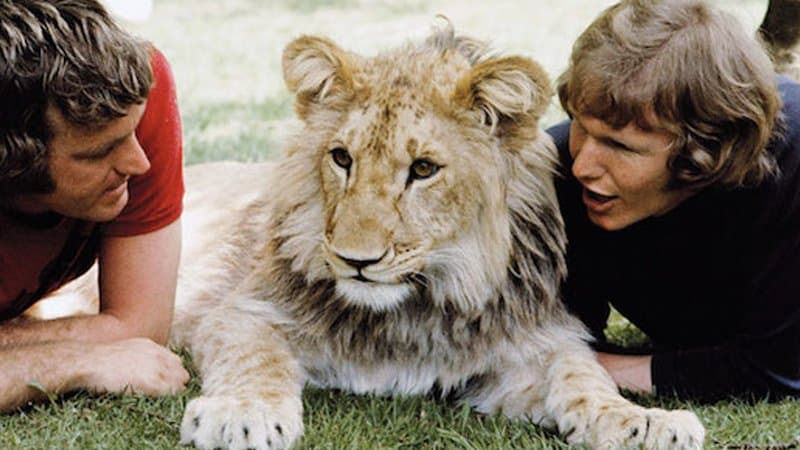
Image: “Anthony Bourke and John Rendell with lion cub Christian in London in the 70s.” by Derek Kattani and Born Free Foundation. 1970s.
Adhering to our animalistic theme, I’d like to introduce to you Kalila wa Dimna, an ancient Indian text containing a collection of fables. According to Professor Nasrin Rahimieh, Kalila wa Dimna was written by Brahman philosopher Bidpai for King Dabshalim, serving as a guide on how to “obtain the loyalty of his subjects”.
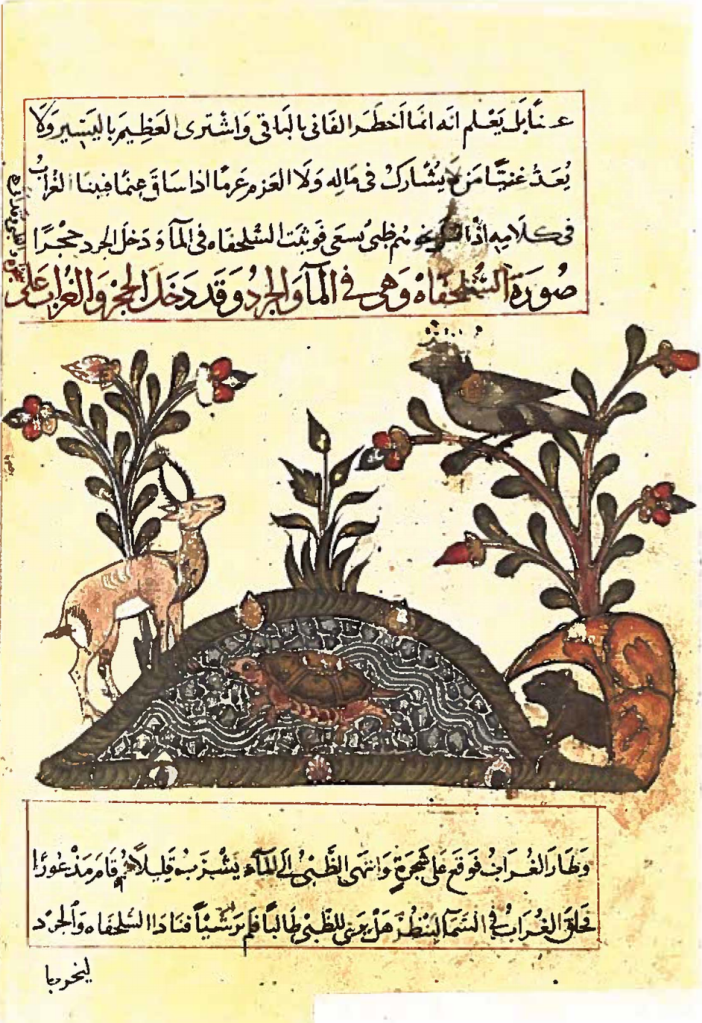
Image: “The Gazelle with the Crow, the Mouse, and the Tortoise” from Kalila wa Dimna. 18th Century.
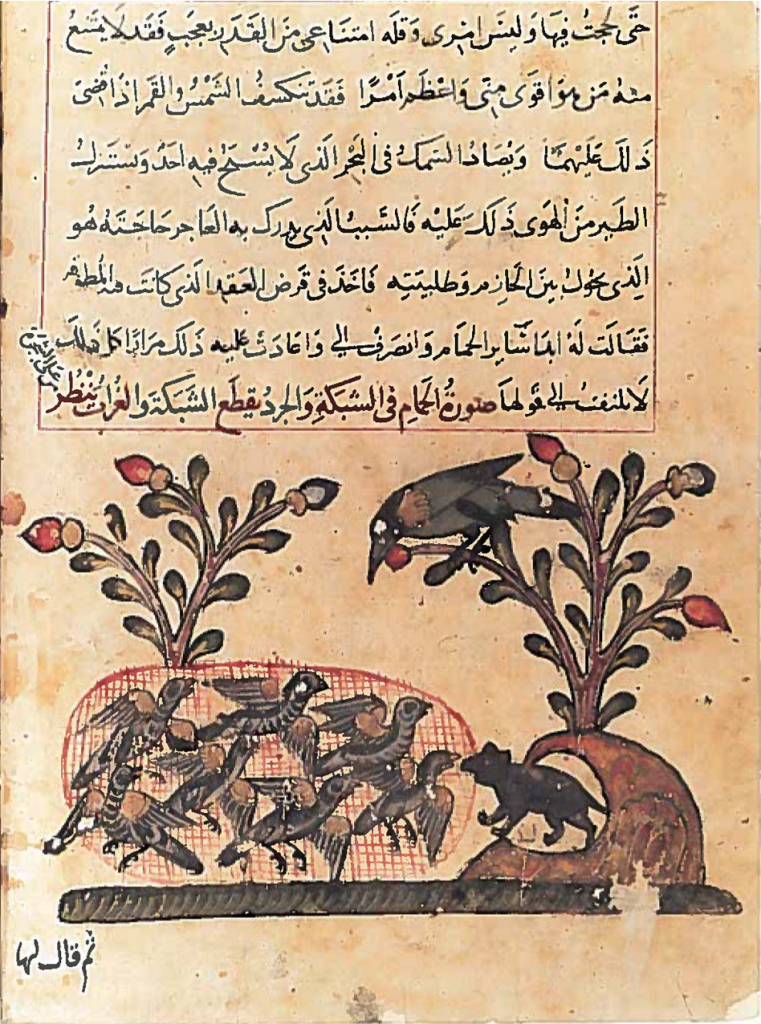
One fable I found interesting within Kalila wa Dimna is one titled “The Ringdove”. The title is somewhat of a misnomer, given that the fable’s protagonists mainly include a gazelle, a tortoise, a mouse, and a crow. Uniting together against the hunter, the group begins to develop a strong, unwavering friendship, coming together daily to “talk about their lives and experiences” and “share their meal together”. In times of danger, the animals do whatever it takes to save their companion, even if it means going against the predator. Eventually, the creatures begin to shift their relationship from a platonic one to a familial one, referring to one another as “brothers”.
Image: “The Mouse Gnawing the Net Imprisoning the Doves” from Kalila wa Dimna. 18th Century.
In stories like Reynard the Fox and the fables by Marie de France, interspecies relationships are often portrayed very negatively. In fact, at certain points, the interactions between different animals often results in severe bodily harm or even death. For instance, in Marie’s “The Wolf and the Crane”, wanting to heal her leader, a crane successfully dislodges his throat by removing the blockage with her beak. Expecting a reward for her deed, the bird is instead met with a cruel jest, with the wolf arguing that her reward was him refraining from killing her whilst in his mouth. Rather than display gratitude, the wolf instead asserts his dominance by reminding the crane of her role as prey and his as the predator.
Image: Reynard the Fox. Drawn by W. Frank Calderon, 1895.
Meanwhile, like in “The Ringdoves”, Reynard the Fox includes an instance of interspecies bonding by having Reynard refer to Bruin the bear as his “uncle”. This relationship immediately collapses once Reynard’s trickery is revealed. Seeking to evade arrest, the sly fox gains Bruin’s trust by giving him this patrimonial title, and once the bear is ensnared in his trap, the trickster makes a quick getaway. Viciously attacked by humans and struggling to escape, Bruin severely disfigures himself and narrowly avoids death.
By referring to one another as “brothers”, the animals essentially ignore all biological relations – basing their bond on friendship rather than blood. Centering their lives around one another, this behavior eventually comes to save them numerous times, with the animals joining their skills together to save their friend in need.
The lessons are clear: Firstly, a “family” isn’t just reserved for those with blood relations; it can also be used for people whose relationships have transcended friendship and into brotherhood. Secondly, by casting aside our differences, we can unite as one, which serves especially useful when it comes to dangerous situations.
Although Kalila wa Dimna was originally meant to be a guide for kings, I believe the lessons within it should be taught to everyone – not just monarchs. Thus, if you’re looking for new reading material, I highly implore you to read a copy of this text. Even if all you manage to get out of reading it is a simple moral, you’re nonetheless taking one step closer to making the world a better place.
Works Cited
Rahimieh, Nasrin. “Mirrors for Princes.” Humanities Core Lecture. Anteater Learning Pavillion, Irvine. 26 November 2019. Lecture.
Moving away from the bestiaries, I invite you to take a look at William Shakespeare’s A Midsummer Night’s Dream. Taking place in Athens, Greece, this play describes the descent of four young lovers into the nearby forest, all of whom seek to escape social responsibility and attain their desired love. Unfortunately, their journey is soon impeded by the antics of the residing fairies, causing lines to be redrawn within this “love square”.
But wait a minute, what’s this got to do with anything? Since when are fairies considered animals? Such questions were the first in mind when I initially began to study this text, and I’m sure you’re thinking the same as well.
Professor Julia Lupton of the University of California, Irvine describes fairies as being “composed of human, animal, and plant characteristics” and whose “power of song and dance allow them to perform the mysteries of life and the rhythms of the seasons.” In this case, while they do embody certain animalistic traits, the fairies seemingly take on the animals’ usual didactic role in literature.
Returning to the story, these creatures serve almost as antagonists in the play, evident by their mischief against the Athenian lovers. Using the love potion, they essentially shift the lovers’ realities by changing who’s in love with who, resulting in broken hearts and near-battles to the death.
What do the fairies’ actions mean for humans as a whole? To answer this question and simultaneously retain the text’s role as a play, I’ve designed a playbill which you can see in the next below.
Image: “A Midsummer Night’s Dream Playbill” by Aizza Romo, with images borrowed from Canva.com. 2019.
Although we would expect our realities to depict the absolute truth, we must remember that said reality is at risk of manipulation. With the influence of an outer force, our reality can essentially turn into fantasy – much to our lack of awareness.
In William Shakespeare’s A Midsummer Night’s Dream, Lysander, Demetrius, and the Fairy Queen Titania fall victim to this manipulation, thanks to Oberon and his right-hand man Puck. With the help of a magical flowers’ extract, Puck enchants the trio and causes them to “fall in love” with people outside of their original affections: Lysander falling out of love with his dearest Hermia, Demetrius falling in love with a once-detested Helena, and Titania falling in love with a rude mechanical-turned ass.
The playbill serves to depict these ideas by using the picture of a forest and a pair of yellow arrows. On one hand, the image of the forest represents the play’s main setting. It is here where the Athenian lovers and the rude mechanicals flee to, and it is here where they fall victim to the fairies’ mischief. On the flipside, given that the image is an optical illusion, it also serves to represent the idea of manipulated realities. It initially appears as if there’s a human eye at the forest’s center. Like all optical illusions, this is simply a matter of perspective – there isn’t really a human eye in the forest, but it appears as if so because of the way the trees have been planted in order to give that image. In the play, Lysander, Demetrius, and Titania aren’t truly in love with their newfound affections; they have simply been “enchanted” into doing so.
The golden arrows on the playbill also support this theme, particularly by serving as an allegory to the love god Cupid and his golden-tipped arrows. In the play, the flower’s love-properties and their subsequent effects on the plot – are as a result of Cupid’s stray arrow. Once more, this idea of shifted realities is represented here with this nod towards Cupid, given his abilities to cause people to fall madly in love with each other no matter their prior feelings.
In essence, we mustn’t put our entire faith into our reality – because they can easily be just as fictional as our fantasies.
Works Cited
Lupton, Julia. “Into the Animated Woods.” Humanities Core Lecture. Anteater Learning Pavillion, Irvine. 5 November 2019. Lecture.




 Humanimals